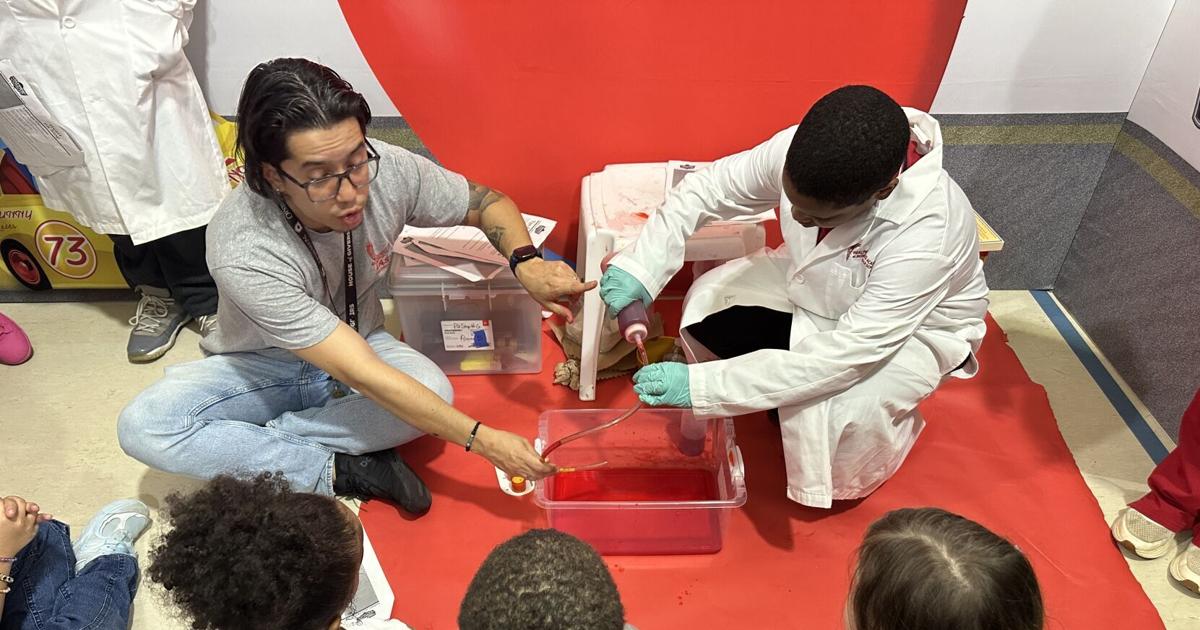
East Elementary School Dual Language Immersion teacher Cristian Bernal and students demonstrate how blood cannot flow through a clogged artery.
Michael Wayne O’Neill/EJ
MONROE, N.C. — As part of the Health Science Academy’s initiative to bring teachable, hands on learning experiences to students and families, East Elementary School brought in a digestive system exhibit that was interactive for all families to walk through and try hands on activities — Speedway to Healthy.
Speedway to Healthy, an exhibit put together by North Carolina A&T’s Cooperative Extension program, is a 1,200-square-foot walk-through exhibit representing the human body, which East Elementary presented to families on Thursday.
The educational exhibit teaches children in kindergarten through 5th Grade how the foods they eat affect their bodies and health.
East Elementary School STEM teacher Jessica Silva was responsible for coordinating with Union County Family and Consumer Sciences (FCS) agent Judith Hernandez to bring the exhibit in. It only took three hours to set up in the gymnasium because most students pitched in to help.
“My vision was to connect what we’ve learned in class to a bigger experience like what does (the digestive system) really look like in our body,” Silva said. “I’m more likely to remember ‘Oh yeah, like in the mouth, they have pictures of cigarettes and things.’ Later in life, they might think back and remember that because it’s so big and so exciting.”
The exhibit begins at the starting line, where children are given a food sticker from a “MyPlate” model. The students then race through the body, pretending to be molecules of food found in the MyPlate food groups. They visit 11 volunteer-led “pit stops” that feature fun, educational activities focused on healthy lifestyle choices.
Health Science Academy student ambassadors who attend East Elementary School were at some of the “pit stops” explaining the different functions of the digestive system to other students and families inside the exhibit.
Hernandez said some of the pit stops include the brain, the mouth, the lungs, esophagus, stomach, bones, muscles.
“They’re going to see every part of the system and have a hands-on activity that they can do. For example, if you go into the mouth, you’ll see a large toothbrush and a bunch of teeth. You are able to brush those teeth. You are able to cross those teeth, so kids get really excited and they can actually put into practice,” she said.
The big takeaway from the exhibit was to remind students what happens in the human body and for the digestive system when one consumes certain foods
“If their family decides ‘Hey, we do need to exercise more,’ we do need to eat less fast food and make better choices,” Silva said. “I think they’re going to find out those things in here because they’re going to see how (choices) affect their heart. They are going to see how it affects their liver, their kidneys, especially through different experiments. When you see it, and you see pictures of how it can happen in your body, and how negative things can affect your body, I think that has a big impact. … it starts at home.”