


Is post-stress sleep the key to bouncing back? Scientists reveal how the brain turns stress into restorative sleep, pointing to new strategies for mental and physical recovery.


In a recent perspective piece published in the journal Neuron, researchers discussed how stress can disrupt and promote sleep and the biological mechanisms that may underlie these responses. They propose that following certain types of stress, particularly emotional or immune challenges, stress-induced sleep, especially as demonstrated in animal models, could serve as an adaptive, protective response that supports recovery by enhancing resilience, mediated by key brain circuits such as the ventral tegmental area (VTA) and lateral habenula. However, the adaptive nature of this response appears highly context-dependent and may not be universally beneficial in all scenarios.
Background
Sleep, which includes rapid eye movement (REM) and non-REM sleep, plays a critical role in human and animal health. While its exact functions remain debated, current research suggests sleep may serve multiple distinct physiological processes, not only in the brain but throughout the body. We know that sleep deprivation results in significant physiological and psychological stress.
Both humans and animals exhibit a strong drive to sleep, with prolonged wakefulness leading to severe outcomes, even death in rodents. However, stress and sleep have a complex relationship: while stress often disrupts sleep by activating arousal systems in the brain, it can also increase the body’s need for sleep.
Arousal during sleep, enabled by systems like the locus coeruleus noradrenergic pathway, is evolutionarily vital for survival. Yet, stress can over-activate these circuits, leading to fragmented sleep and reduced quality.
Most research focuses on how stress causes insomnia, but this article focuses on stress-induced sleep, a paradoxical response seen under specific conditions. Understanding this adaptive mechanism may uncover new strategies for leveraging sleep to enhance resilience and recovery from stress.
“Sickness sleep”: a stress response?
Stress is a broad biological and psychological phenomenon involving disrupted internal balance in response to perceived threats. While many stressors trigger arousal and insomnia, only certain stress types, like illness or intense emotional experiences, promote sleep.
These stress-induced sleep responses may share underlying molecular mechanisms that activate sleep-promoting brain circuits. One example is “sickness sleep,” a conserved response across species where infection or inflammation induces increased sleep.
This behavior is thought to support recovery and healing. Similarly, in rodent models, specific emotional stressors reliably trigger increased sleep.
Social defeat stress (SDS), exposure to predator scents, unpredictable chronic mild stress (UCMS), and foot shock have all been shown to increase sleep under certain conditions.
Depending on how experiments are set up, these stressors can also trigger arousal, but their ability to promote sleep is striking. The paper emphasizes that the same stressor may result in insomnia or increased sleep, depending on the experimental context, environment, and timing. This highlights the complexity of stress–sleep interactions in both animal and human research. Such findings suggest that sleep might function as a protective, adaptive response to specific forms of stress, enhancing the body’s ability to recover and cope.

Sleep for Promoting Recovery
In animals, sleep after illness or injury (especially non-REM sleep) promotes physiological healing, such as better heart recovery. Similarly, following emotional stress, increased non-REM or REM sleep improves anxiety, social behavior, and resilience.
For example, in mice, stress-activated, sleep-promoting neurons—such as GABAergic cells in the ventral tegmental area (VTA)—reduce anxiety and promote social recovery after stress. REM sleep may help extinguish traumatic memories, with its loss increasing emotional vulnerability.
While stress is often linked to insomnia in humans, recent studies show nuanced effects. For example, social stress before sleep can increase deep sleep, and more post-trauma sleep (especially REM) may reduce intrusive memories. However, the benefits vary due to individual differences, context, and unmeasured factors like sleep architecture.
People with depression often show prolonged REM sleep. While some treatments suppress REM, animal data suggest REM may help emotional processing. This contradiction raises the possibility that REM sleep’s role depends on the context and could be both adaptive and maladaptive. The original perspective notes that while antidepressant drugs often suppress REM sleep, it is still unclear whether this suppression is beneficial, and some animal data suggest that REM sleep itself may be part of an adaptive stress recovery process.
Surprisingly, immediate sleep deprivation after trauma may reduce traumatic memory formation, as shown in both human and rodent studies. This paradoxical finding highlights that, in some contexts, delaying sleep after trauma can blunt the consolidation of aversive memories, though the mechanisms remain to be fully elucidated.
Conclusions and Unanswered Questions
Sleep following stress may aid recovery by supporting essential neurobiological processes. In animal models, resilient individuals often sleep after stress, suggesting that this response helps restore balance. However, the mechanisms linking physical tiredness, stress, and the need to sleep are still unclear, and more evidence from human studies is required.
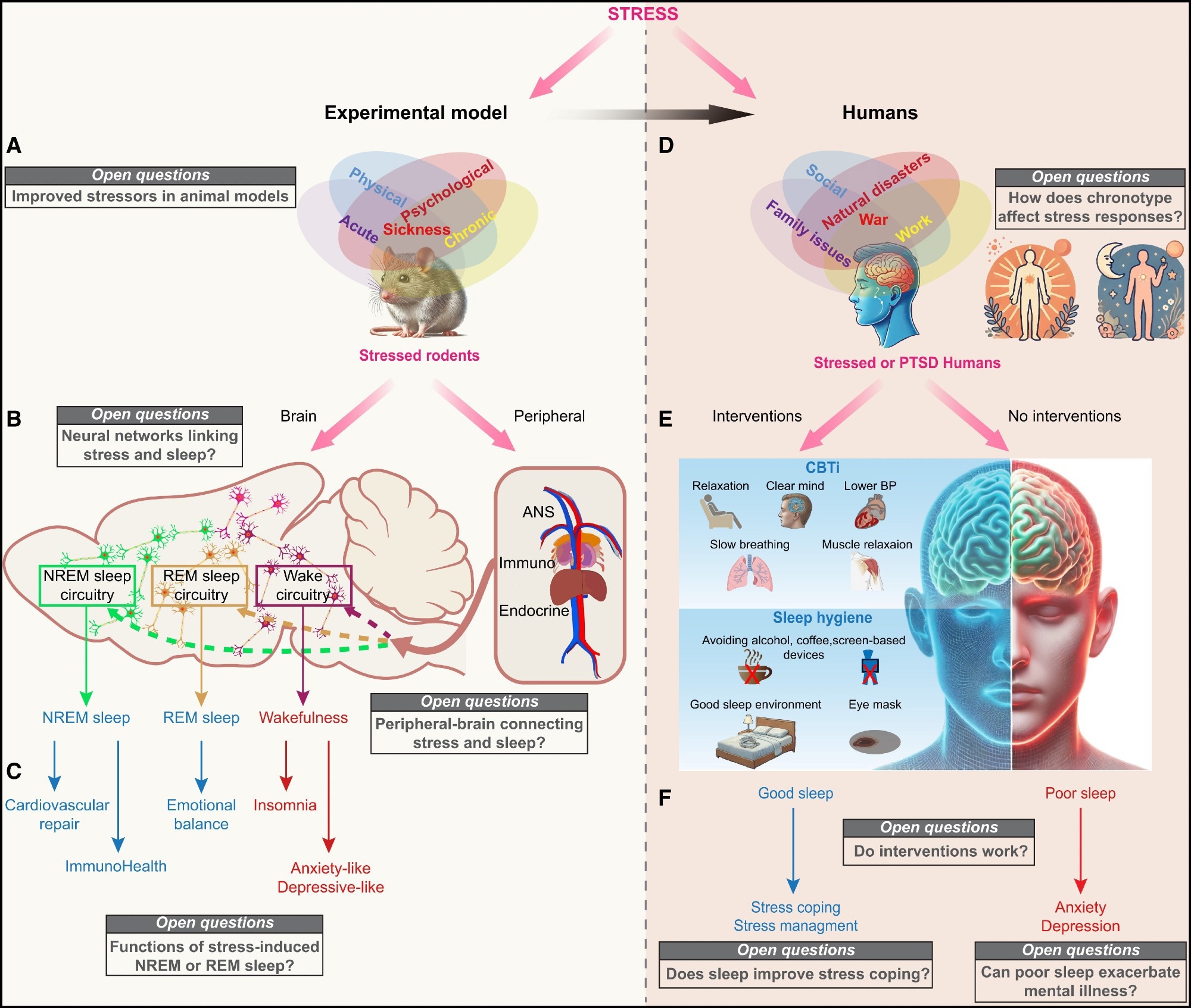
Animal models can be improved by developing stress paradigms that better reflect human physical and psychological stress. In terms of neural mechanisms, we currently lack a comprehensive understanding of the circuits and neuromodulators that link stress and changes in sleep.
Stress likely alters hormonal and immune systems, influencing sleep in ways that are not yet well understood. Time may also be a factor, with preferences towards mornings or evenings influencing sleep recovery and responses to stress.
Overall, post-stress sleep likely aids coping and recovery, but its effects depend on stress type, timing, sleep stage, and individual factors. The article highlights several open questions, such as how chronotype affects stress-sleep interactions, how specific neural circuits mediate these effects, and whether interventions targeting sleep can reliably buffer stress-related disorders.
Improving sleep through cognitive behavioral therapy or interventions that promote sleep hygiene could buffer stress and enhance resilience. A better understanding of these interactions could shape novel treatments for stress-related disorders.
link